

Right to Know
The Delaware County Conservation District is subject to Pennsylvania’s Right to Know Law, 65 P.S. § 67.101, et seq., which gives the public access to certain public records of governmental bodies.
Submitting a Right to Know Request
A request under the Right to Know Law may be submitted in hardcopy or by e-mail to:
Michelle Wheeler, Permitting Manager
Delaware County Conservation District
Rose Tree Park – Hunt Club
1521 N. Providence Road
Media, PA 19063
FerriM@co.delaware.pa.us
A form for such requests may be found at the following link:
https://www.openrecords.pa.gov/Documents/RTKL/RTKRequestForm.pdf
Further information on the Right to Know Law, including a copy of the statute, may be found at the following link:
https://www.openrecords.pa.gov/RTKL/About.cfm


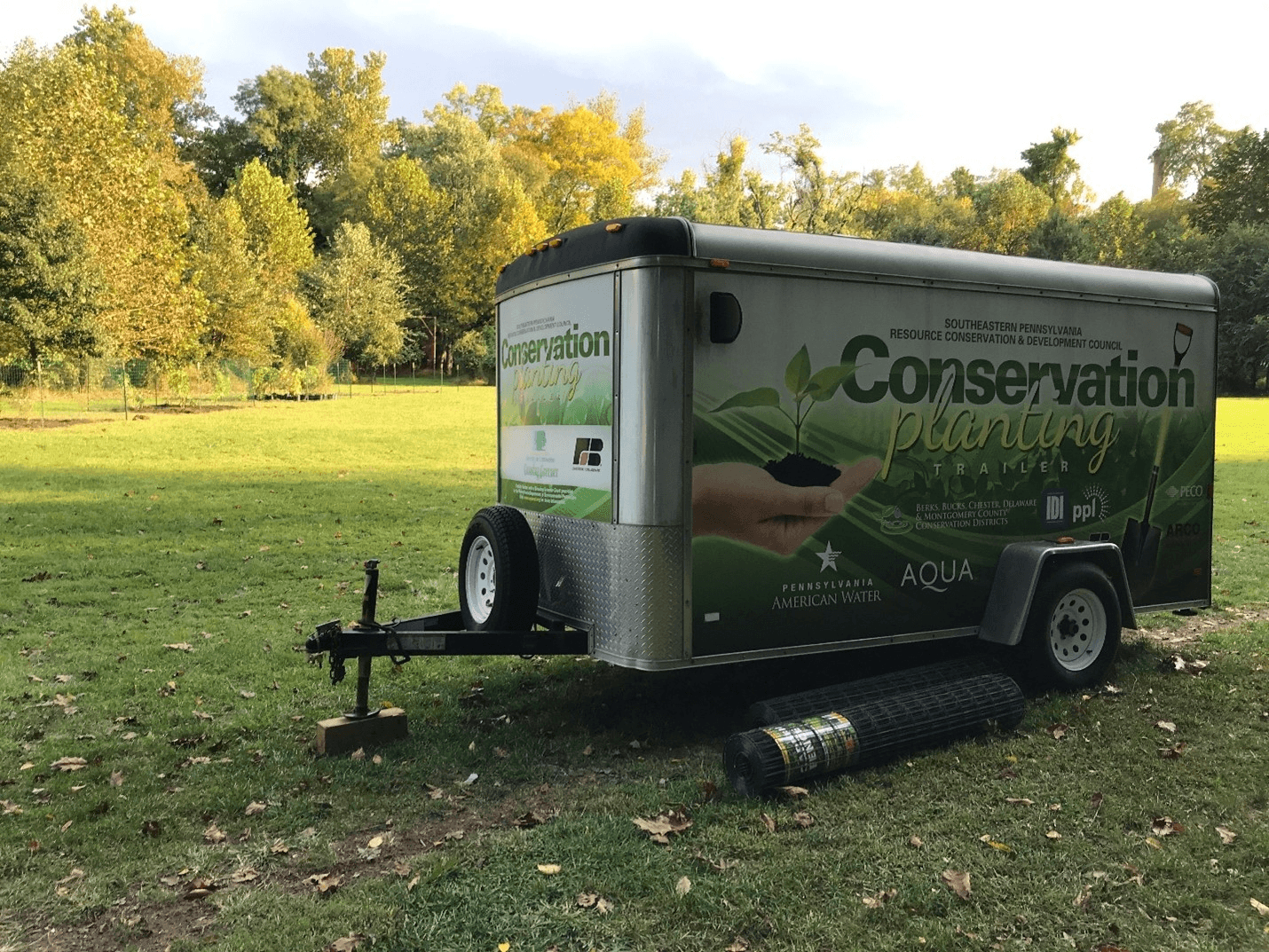
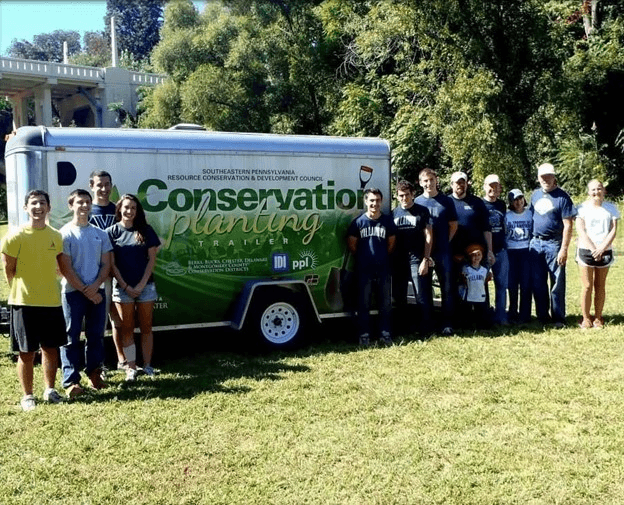
The Conservation Planting Trailer was created by the Southeast PA Resource Conservation and Development Council (SEPA RC&D Council) to assist conservation groups with their planting projects. The trailer is fully stocked with anything you could need to have a successful planting event, and you can lock it up overnight at your site. It helps to have the right tools for the job, and to have access to those tools at your planting site.
The trailer is free to use and given on a first come, first serve basis. If you are interested in borrowing the tool trailer for a conservation project, contact the Watershed Specialist for your county to schedule your dates:
Delaware: Chris Cook, CookC@co.delaware.pa.us
Montgomery: Brian Vadino, bvadino@montgomeryconservation.org
Chester: Cori Trice, ctrice@chesco.org
Bucks: Karen Ogden, kogden@bucksccd.org
2025
TOWN WATCH FOR THE ENVIRONMENT
The Conservation District depends upon the local community to refer sediment pollution violations to us. We do perform as many routine inspections as possible, but the number of sites active in the County is overwhelming at times. If you witness best management controls that are not maintained, or sediment pollution to a stream or wetland please feel free to give us a call at (610) 892-9484.
The PA Department of Environmental Protection (DEP) administers the majority of PA’s environmental programs. DEP has made it easy to direct your concerns to the right division, no need to call Harrisburg.
They have created a complaint service representative position to receive all complaints and log them into a statewide computer database. These complaints are then directed to the person responsible for action. The goal is to provide a timely written response to all complaints. In a case where the caller does not feel comfortable leaving their name and phone number, they are given an identification number which they can use when inquiring about their complaint. To register a complaint, call between 8:00 am to 4:00 pm at 484-250-5991. After hours and on weekends, emergency situations should be directed to the Emergency Response Team at 484-250-5900.
Southeast Service Representative
Lisa Miller (484) 250-5991
Online Complaint Form
More Information about Environmental Complaints
2026
| Board Of Directors Meeting Agenda |
|---|
| Agenda - 11/9/2026 |
| Agenda - 11/9/2026 - Low Volume Road Program Quality Assurance |
| Agenda - 1/26/2026 |
| Agenda - 2/3/2026 |
| Agenda - 2/3/2026 - Low Volume Road Program Quality Assurance |
| Agenda - 3/3/2026 |
| Agenda - 4/7/2026 |
| Agenda - 5/5/2026 |
| Agenda - 6/2/2026 |
2025
| Board Of Directors Meeting Agenda |
|---|
| Agenda - 1/7/2025 |
| Agenda - 2/4/2025 |
| Agenda - 3/4/2025 |
| Agenda - 4/1/2025 |
| Agenda - 5/6/2025 |
| Agenda - 6/3/2025 |
| Agenda - 7/22/2025 |
| Agenda - 9/9/2025 |
| Agenda - 9/9/2025 - Low Volume Road Program Quality Assurance |
| Agenda - 10/7/2025 |
| Agenda - 11/5/2025 |
| Agenda - 12/2/2025 |
2024
| Board Of Directors Meeting Agenda |
|---|
| Agenda - 12/3/2026 |
Erosion and Sedimentation (E&S)/ NPDES Permitting
The Conservation District has entered into two delegation agreements to assist the Pennsylvania Department of Environmental Protection (DEP) and the regulated community with environmental permitting. The two delegations involve the Chapter 102 – Erosion and Sediment Control Program and Chapter 105 – Dam Safety and Waterway Management.
The “Chapter” term refers to the section in which the program is outlined in the Department of Environmental Protection’s rules and regulations.
Click the links below for PA DEP’s overview of the permits and related resources:
Chapter 102 E&S Permit Overview
Chapter 105 General Permit Overview
More information on Delaware County permits is in the following sections.
Chapter 102 Erosion & Sedimentation (E&S)/NPDES Permit
 Chapter 102 of the Pennsylvania Code requires permits from the Department of Environmental Protection (DEP) for construction activities that involve earth disturbances greater than or equal to one acre. This includes various activities such as:
- Construction projects with earth disturbances of one acre or more (excluding agricultural plowing or tilling).
- Timber harvesting and road maintenance activities involving 25 or more acres of disturbance.
- Oil and gas activities that disturb five or more acres of land.
General NPDES Permit Fees:
$500 administrative filing or “base” fee paid to Delaware County Clean Water Fund plus
$100 for each disturbed acre payable to the Commonwealth of PA Clean Water Fund
Individual NPDES Permit Fees:
$1,500 administrative filing or “base” fee paid to Delaware County Clean Water Fund and $100 for each disturbed acre payable to the Commonwealth of PA Clean Water Fund
We’ve updated our E&S Fee Schedule, effective April 20th, 2026.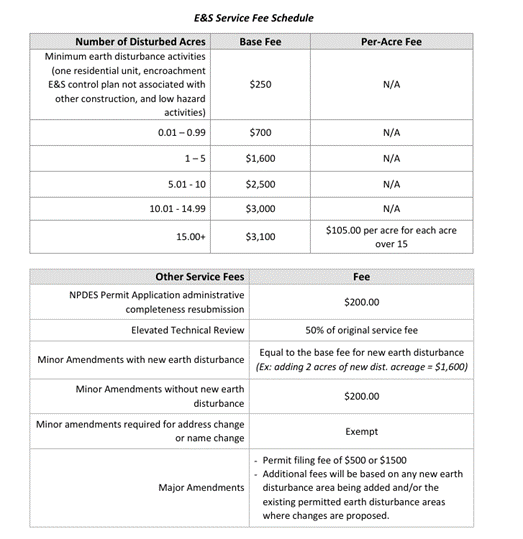
Further Information about E&S/NPDES Permits:
E&S Control Plan Guidelines
DEP's E&S resources
DEP's Construction Stormwater Website
Agriculture Erosion and Sediment Control Website
Review Permits in the PA Bulletin
Submit E & S Control Plan here
Chapter 105 Streams and Wetlands Permit
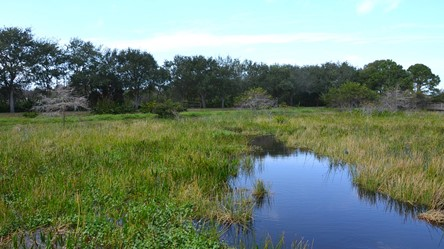 Many activities in Pennsylvania streams, lakes, ponds, or wetlands require a permit from the Pennsylvania Department of Environmental Protection (DEP) to protect public health, safety and the environment. These are activities that change, expand, or diminish the course, current, or cross section of a watercourse, floodway, or waterbody are termed encroachments, obstructions in certain cases, and are regulated by Chapter 105 regulations (PA DEP). There are 12 different GPs, each related to a particular activity. DCCD handles permits for GP’s 1-9.
To obtain this permit, you must check your eligibility for the specific GP, calculate your fees using the Chapter 105 Fee Calculation Worksheet, and submit your application online.
Chapter 105 General Permit Information
- GP 1: Fish habitat enhancement structures (not in wetlands)
- GP 2: Small docks & boat launching ramps (≤750 sq ft)
- GP 3: Bank rehabilitation, protection, and gravel bar removal (≤500 ft length, ≤6" depth)
- GP 4: Intake & outfall structures
- GP 5: Utility line stream crossings
- GP 6: Agricultural crossings/activities
- GP 7: Minor road crossings
- GP 8: Temporary road crossings
- GP 9: Agricultural activities
- GP 10: Abandoned mine reclamation
- GP 11: Maintenance, repair, or replacement of existing obstructions/encroachments
- GP 15: Private residential construction in wetlands
What can and can’t I do to a stream without a permit?
Check this out: Stream Maintenance
Pennsylvania Natural Diversity Index (PNDI)
The Pennsylvania Natural Diversity Inventory (PNDI) Environmental Review is a web-based tool used to evaluate potential impacts of proposed projects on threatened, endangered, and special concern species and their habitats within Pennsylvania.
PNDI Environmental Review specifically analyzes a project’s footprint against species locations and recommends conservation measures, avoidance strategies, or next steps required for regulatory compliance.
National Pollution Discharge Elimination System (NPDES)
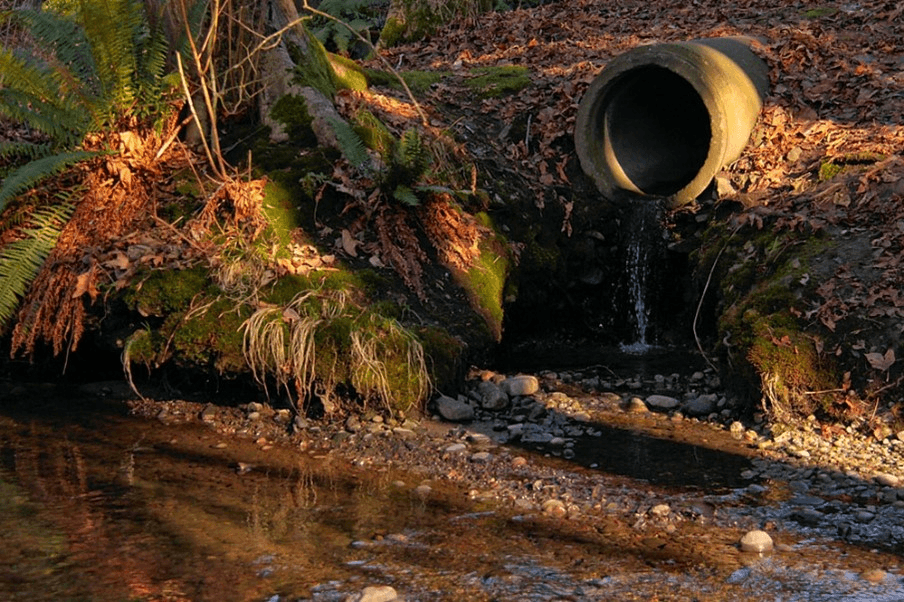 The Clean Water Act of 1972 has greatly improved the quality of the Nation’s waterways. The NPDES program originally regulated point discharges such as those from STPs and factories. It has since been expanded to address nonpoint source pollution resulting from stormwater. Phase I of the NPDES stormwater program sets permit requirements on medium to large municipal separate storm sewer systems that serve 100,000 people or more, as well as construction sites greater than five acres, and 10 separate categories of industrial sources.
The Phase II program requires all owners and operators of small municipal separate storm sewer systems in urbanized areas as defined by the Census Bureau and owners and operators of small construction sites the disturb 1 to 5 acres of land to obtain an NPDES permit. Every municipality in Delaware County meets these criteria and is therefore required to have a permit.
Permits are issued by DEP to each municipality based on a 5-year time frame. Requirements of the permit are to implement programs to address the following 6 Minimum Control Measures:
- Public Education and Outreach
- Public Involvement and Participation
- Illicit Discharge Detection and Elimination
- Construction Site Stormwater Runoff Control
- Post Construction Stormwater Management in New Development and Redevelopment
- Pollution Prevention and Good Housekeeping for Municipal Operations and Maintenance.
Many of these elements can be addressed through municipal stormwater ordinances such as those developed as part of an Act 167 Stormwater Management Plans.
The County, in an effort to assist the municipalities in meeting part 1 and 2 of these requirements, has run educational advertisements in the Daily Times as well as distributed stormwater bookmarks to all the libraries in the County libraries. The County further assists municipalities with the development of Act 167 plans and information distribution concerning regulation requirements.
More information on MS4 permits:
DEP Municipal Stormwater Website
MS4 NPDES Permit
EPA MS4 Information
What can you do to help reduce stormwater pollution?
Stormwater runoff is generated from rain and snowmelt events that flow over land or impervious surfaces, such as paved streets, parking lots, and building rooftops, and does not soak into the ground. The runoff picks up pollutants like trash, chemicals, oils, and dirt/sediment that can harm our rivers, streams, lakes, and coastal waters. To protect these resources, communities, construction companies, industries, and others, use stormwater controls, known as best management practices (BMPs). These BMPs filter out pollutants and/or prevent pollution by controlling it at its source.
The NPDES stormwater program regulates some stormwater discharges from three potential sources: municipal separate storm sewer systems (MS4s), construction activities, and industrial activities. Operators of these sources might be required to obtain an NPDES permit before they can discharge stormwater. This permitting mechanism is designed to prevent stormwater runoff from washing harmful pollutants into local surface waters (EPA).
- Learn more about our watersheds
- Caring for Your Streamside Property Brochure
- EPA NPDES Stormwater Program
- Villanova Urban Stormwater Partnership
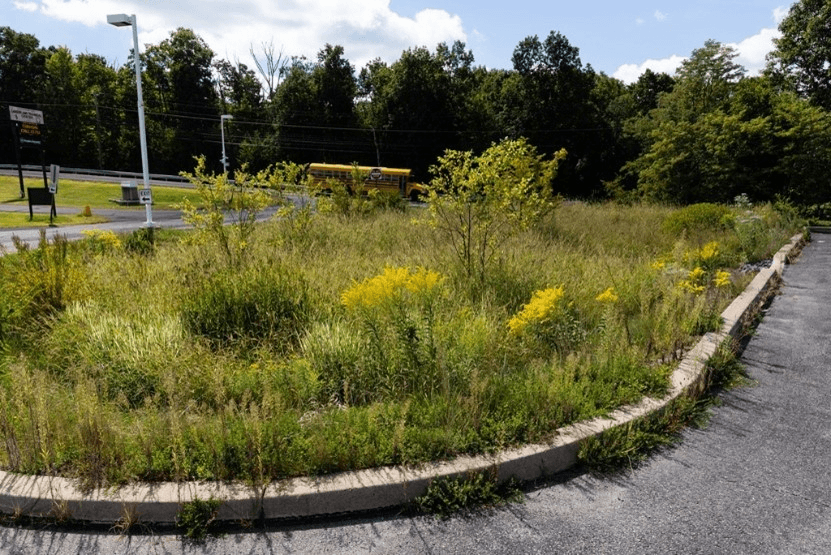 Shown in the picture is a rain garden, which is a shallow, landscaped depression designed to capture and absorb rainwater runoff. Planted with water-tolerant native vegetation, it filters out pollutants and temporarily holds water, allowing it to slowly soak into the ground rather than causing flooding or carrying contaminants into local waterways.
A rain garden is a great way to reduce stormwater pollution, and you can create one at home!
167 Stormwater Management Plans
Recognizing the need to deal with the problems associated with stormwater runoff, the Pennsylvania General Assembly enacted Act 167 in 1978, the Pennsylvania Stormwater Management Act. This act, which is the “sister” legislation to Act 166, FP Management Act recognizes the interrelationship between land development, accelerated runoff, and floodplain management. While Act 166 requires municipalities to regulate development in the floodplain, Act 167 requires municipalities to implement a stormwater management ordinance limiting stormwater runoff from new development.
The Act requires Pennsylvania counties to prepare and adopt stormwater management plans for each watershed located in the county, as designated by the Pennsylvania Department of Environmental Protection. Most importantly, these plans are to be prepared in consultation with municipalities located in the watershed, working through a Watershed Plan Advisory Committee (WPAC). The plans are to provide uniform technical standards and criteria throughout a watershed, for the management of stormwater runoff and from new land development and redevelopment sites.
The types and degree of controls that are prescribed in the watershed plan need to be based on the expected development pattern and hydrologic characteristics of each individual watershed. The management plan, specifically the standards and criteria, are developed from the technical evaluations performed in the planning process to respond to the “cause and effect” nature of existing and potential storm runoff impacts in the watershed. The final product of the Act 167 watershed planning process is a comprehensive and practical implementation plan and stormwater ordinance developed with a firm sensitivity to the overall needs (e.g. financial, legal, political, technical, etc.) of the municipalities in the watershed. Every municipality within the watershed must adopt the ordinance.
Act 167 Plans Status in Delaware County include:
- Ridley Creek (1988)
- Chester Creek (2003)
- Darby-Cobbs Creeks (2005)
- Crum Creek (In Progress)
- Brandywine Creek (only small land area in Delaware County, plan to be prepared by Chester County)
Municipal Separate Stormwater Reports
MS-4 Required Plans
Public Education and Outreach Program
Operation and Maintenance Plan of Vehicles
Illicit Discharge Detection and Elimination Program
For further information on what your municipality is doing to meet NPDES requirements, contact your local municipal office.
Delaware County Envirothon 2026 | Annual Poster Contest | Upcoming Events
 The Envirothon is an environmental competition in which teams of five students, grades 9 through 12, compete against other Delaware County High Schools teams in five subject areas: Soils, Aquatics, Wildlife, Forestry, and a current issue topic which is updated each year. Every high school is permitted to send two teams of five to the event.
Study materials and various publications are available to educators to help their students prepare for the event. High Schools who currently participate develop teams in various ways such as: Environmental clubs, incorporation of material into classroom activities and rewarding students who perform well by placing them on the team, or a host of other methods.
Tests are developed by professionals in each area of expertise: PA Fish & Boat Commission, PA Game Commission, DCNR – Forestry, and the U.S.D.A. Natural Resource Conservation Service. Envirothon events are also conducted on the State and National levels. The Envirothon is locally sponsored by the following organizations:
DCNR State Parks, Delaware County Environmental Network
The first-place team is eligible to compete in the statewide competition. The statewide competition involves over 60 teams from across Pennsylvania. Only one entry from each County is permitted. The local winner will receive funds to assist with expenses in attending the State competition.
Any school who is interested is encouraged to contact Delaware County Conservation District. We will supply you with the necessary information and more study materials.
Station Training - Pennsylvania Envirothon
Pennsylvania Envirothon - Educating high school students in natural resource and environmental sciences
Delaware County Envirothon 2026
FIRST PLACE WINNERS!

Content Slider 2
Chester Creek
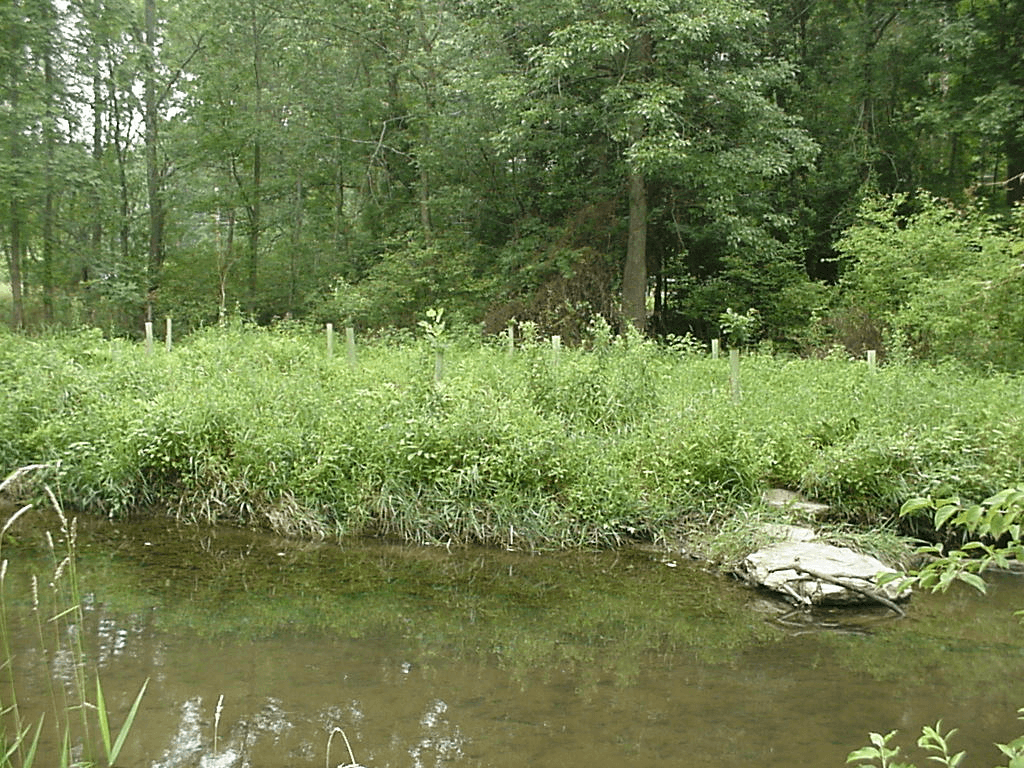
Chester Creek at Newlin Grist Mill along Route 1
For More Information Contact
Delaware County Conservation District
Rose Tree Park- Hunt Club, 1521 N. Providence Rd.
610-892-9484
Info@delcocd.org